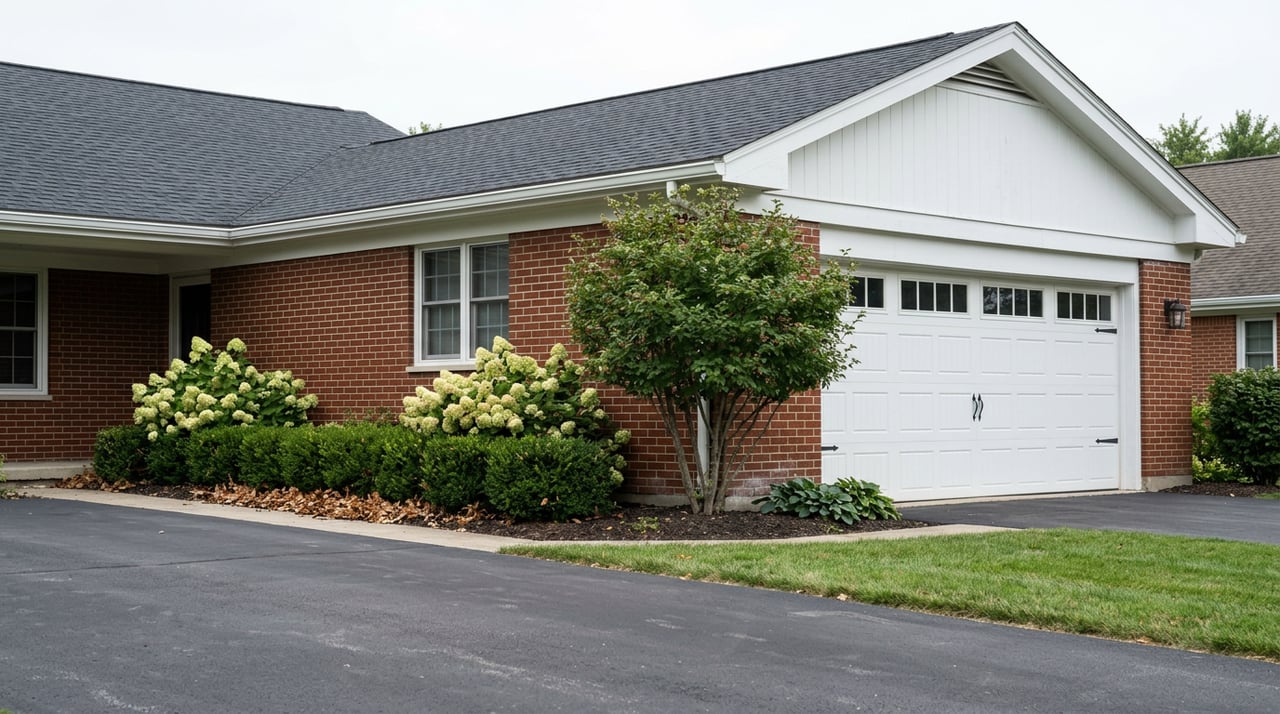
New Albany Links' own design guidelines put the whole problem in nine words: "City project approval does not constitute ARB approval." The reverse is also true. A homeowner who gets a signature from one board has often gotten nothing at all from the other.
That single line explains more about how renovations and resales actually go in New Albany than any glossy description of Georgian brick and four-sided architecture ever will. This is a city where the exterior of a house is reviewed twice, by two boards that don't share paperwork, don't answer to each other, and don't consider their job done when the other one is finished.
If you're buying a home here, planning a renovation, or getting ready to list one that's had work done in the last few years, this is the mechanism you need to understand before you touch a driveway, a garage door, or a can of paint.
Two Boards, Same House, No Overlap
The City of New Albany runs its own Architectural Review Board under Chapter 1157 of the city code, which sets up an Architectural Review Overlay District covering nearly every zoning district in the city outside of a few technology and industrial areas. That board has seven members, meets at Village Hall, and issues what the code calls a Certificate of Appropriateness before most exterior changes can move forward. City council's most recent update to this chapter took effect in September 2025, which is a useful reminder that the rules here are not something you read once and file away. They get revised.
Separately, if your address sits inside one of New Albany's HOA-governed communities, that HOA runs its own Architectural Review Board or Committee, with its own members, its own guidelines, and its own timeline. New Albany Links has a five-member board that sometimes brings in a licensed architect for larger projects. The New Albany Country Club community works with an architect, David B. Meleca, through its Architectural Review Committee, and routes paperwork through Ohio Equities, the management company that also handles administration for several other associations in town.
None of these HOA boards report to the city board. None of them are bound by what the city board approves. A homeowner can walk out of a city hearing with a Certificate of Appropriateness in hand and still be in violation of their HOA's design guidelines, or the other way around.
What the Two Tracks Actually Look Like Side by Side
| City Architectural Review Board | Typical HOA Architectural Review Board | |
|---|---|---|
| Governs | All properties in the Architectural Review Overlay District | Only homes inside that specific HOA |
| Standard for review | Compatibility with the city's historic and architectural character | Compliance with that community's design guidelines |
| Typical turnaround | Varies by project, reviewed at board meetings held at Village Hall | About 30 days for most submissions |
| Paint or solar projects | Follows the same certificate process | Often 60 to 90 days, since solar and paint require more deliberation |
| Fee for skipping approval | Municipal penalties tied to code violations | Often a flat compliance fee |
| Appeals | Heard by the city board itself under Chapter 1157 | Determined by that HOA's board, at its discretion |
The two systems can move at different speeds, use different vocabulary, and reach different conclusions about the same project. A homeowner who assumes "the board" is one thing is planning around a board that, in most of New Albany's HOA communities, does not exist as a single entity.
The Specifics That Trip People Up
The city's design standards focus on broad compatibility. HOA guidelines get far more granular, and this is where buyers and sellers are most often caught off guard. A local remodeling contractor, Columbus Suburban Construction, has summarized some of the citywide expectations, and New Albany Links publishes its own design guidelines in even more detail. Between the two, a few rules stand out because they surprise people who assume "matching brick" covers the whole standard:
- Citywide, driveways are expected to be black asphalt, not concrete.
- Citywide, garage doors may only feature glass in the upper panels.
- Within New Albany Links, brick and stone cannot be painted, even when siding and trim colors are being updated.
- Within New Albany Links, deck flooring and stair treads are limited to brown and gray tones, and the space underneath must be framed and enclosed with wood skirting.
- Within New Albany Links, exterior paint changes routinely take longer to approve than other projects, because board members want to view color samples at different times of day before signing off.
These standards appear in published citywide guidance and HOA guidelines. Buyers and sellers should check the rules that apply to a specific property before planning exterior work. A buyer planning to repaint brick in New Albany Links should check that community's guidelines; a seller with a concrete driveway extension should check the citywide driveway standard.
Why This Follows the House, Not the Owner
Here is the detail that matters most at resale. New Albany Links' own guidelines state plainly that all approval-related documentation must be maintained by the homeowner and transferred to subsequent homeowners.
That means the paper trail for a deck, a fence, a patio, or a solar installation is supposed to travel with the house at closing, the same way a warranty or a survey does. In practice, it doesn't always happen. A seller who added a patio a decade ago and never kept the approval letter puts the next owner in the position of proving compliance for work they didn't do. If no record exists on either side, either with the HOA's management company or with the city, its approval status may be unclear.
This is less a legal risk than a timeline risk. A missing approval letter can slow down a transaction, complicate an appraisal conversation, or become the thing a buyer's attorney flags during due diligence. It's a paperwork gap, and it's entirely avoidable if both sides know to ask for it early.
What to Ask Before You Write an Offer, or Before You List
If you're buying a home in a New Albany HOA community and the listing mentions any addition, deck, patio, fence, or exterior color change:
- Ask the seller for both the city's Certificate of Appropriateness (or a "no permit required" notice, which the city also issues) and the separate written approval from the HOA's board.
- If either document is missing, ask whether the HOA's management company, such as Ohio Equities, has a record on file. Approvals are tracked internally even when the homeowner's copy is lost.
- Before starting any project yourself, budget for both timelines. Thirty days is a reasonable planning window for most HOA submissions, but paint and solar can run 60 to 90 days, and the city's own review adds a separate track entirely.
If you're selling, the fastest way to remove this from the conversation is to gather your own approval letters before the home goes on the market, rather than fielding the question during an inspection period.
A Few Common Questions
Does every home in New Albany fall under an HOA architectural board? No. The city's Architectural Review Overlay District applies broadly across most zoning districts, but the additional HOA layer only applies inside specific communities such as New Albany Links or New Albany Country Club, each of which has its own board and guidelines.
What happens if a past owner skipped approval and it's discovered after closing? It varies by project and by board, but compliance fees are common for structural changes made without prior sign-off.
Is emergency repair work exempt from all of this? New Albany Links' Architectural Review Board says emergency repairs still require written approval afterward, and that the board decides what counts as an emergency.
New Albany's two-board system rewards homeowners who ask questions early and keep paperwork organized. It penalizes the assumption that one approval covers the whole house. If you're weighing a purchase, a renovation, or a listing in one of these communities and want a second set of eyes on what's already on file for a specific address, The Lundquist Group offers a free home consultation to help you sort out exactly what's been approved, what hasn't, and what that means for your timeline.
This article is general information, not legal, tax or financial advice. Consult a qualified professional about your situation.